Virtual practice labs using virtual reality (VR) technology – a trend in education and training in the 4.0 era
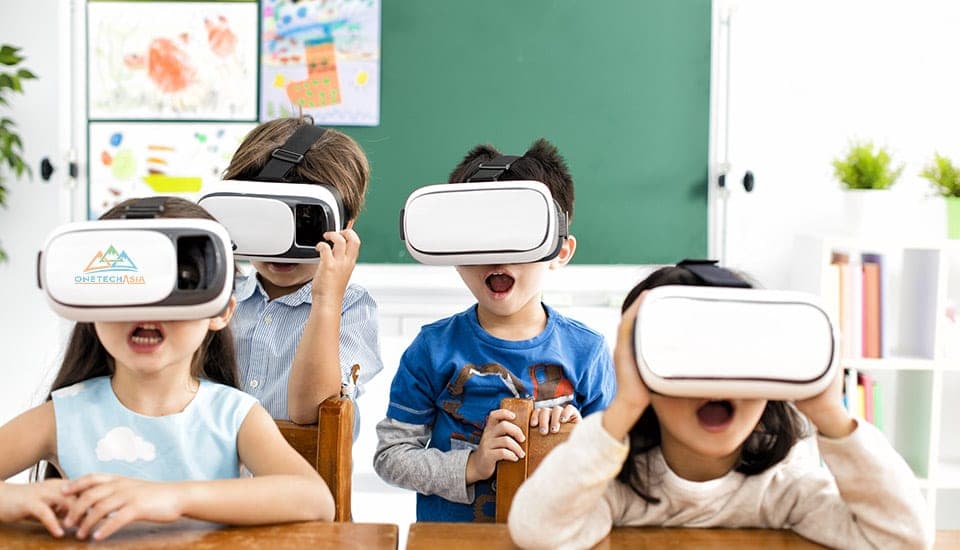
In the era of the Fourth Industrial Revolution (Industry 4.0), education is undergoing reforms in methods combined with new technologies. Among them, virtual reality (VR) offers pupils and students new approaches that make lessons easier to absorb and apply more effectively.
The 8th Plenum of the 11th Central Committee of the Communist Party of Vietnam adopted the Resolution on fundamental and comprehensive reform of education and training to meet the requirements of industrialisation and modernisation in the context of a socialist-oriented market economy and international integration; the National Assembly issued Resolution No. 88/2014/QH13 on the reform of general education curricula and textbooks, contributing to the fundamental and comprehensive reform of education and training. The reform objective set out in Resolution 88/2014/QH13 of the National Assembly is: “To reform general education curricula and textbooks in order to bring about a fundamental and comprehensive change in the quality and effectiveness of general education; to combine teaching knowledge, character education and career orientation; and to help shift an education system focused mainly on transmitting knowledge to one that develops learners comprehensively in both qualities and competencies, harmonising moral, intellectual, physical and aesthetic education and making the best of each student's potential.”
The guidance on educational methods in the new General Education Curriculum (2018), issued together with Circular No. 32/2018/TT-BGDĐT dated 26 December 2018 of the Minister of Education and Training (MOET), contains the section “Students' learning activities include problem-exploration activities, practice activities and hands-on activities (applying what has been learned to identify and solve real-life problems), carried out with the support of teaching equipment, especially information technology tools and digital automation systems.” Therefore, stepping up the application of scientific and technological achievements, especially information technology, in education and training in order to improve quality and learners' initiative is an urgent requirement.
Virtual reality technology first began to emerge in the late 1960s and has been known by many names, such as synthetic environment, cyberspace and artificial reality. These technologies laid the foundation for the development of today's virtual reality technology.
Virtual reality (VR) technology is a type of technology that integrates multimedia content to convey information and allows users to interact with the elements of that content. VR uses computer graphics to create a “lifelike” three-dimensional world with which participants can interact. Moreover, this “artificial” world is not static but changes according to the user's interaction (input signals), such as actions or speech. This defines a key characteristic of VR: real-time interactivity.
Virtual reality (VR) is an environment that simulates the real world. It is created by people, and within that environment all images and mechanisms act directly on the human senses, allowing users to move forward, backward, and turn left or right to obtain the most realistic views and an impressive virtual reality experience. Applying virtual reality in education is a breakthrough in teaching methods and a new approach for both learners and teachers: instead of rote learning and purely theoretical study, they move to practical learning and real-world experience through 3D simulations and laboratories, so lessons and knowledge become practical, detailed, quick to understand and easy to remember, engaging learners and being many times more effective than the old way. Imagine how lessons could become more interesting, lively and effective. Teachers use VR technology to explain historical events and subjects such as science and biology. Any passive or dull event or piece of knowledge can be turned into something lively and more interesting, or learners can see in detail how things work… Schools are being digitised and can use computers and mobile applications for their lessons.
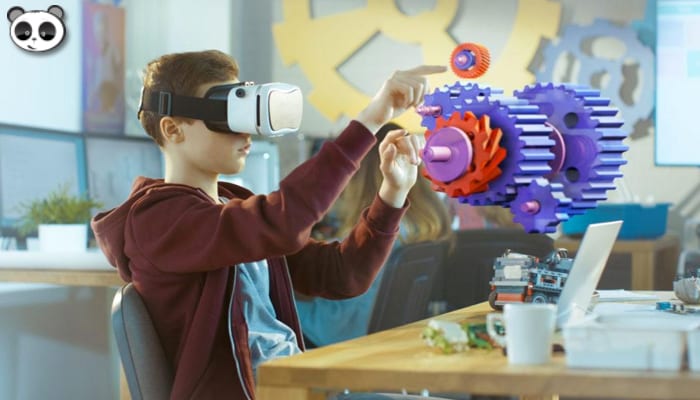
As an inevitable trend in a context of rapid technological development, educators are beginning to rely on VR simulations to develop learning experiences. Applying VR technology in teaching provides learners with a new learning platform that is more effective than traditional teaching methods.
Today, the integration of interactive multimedia content such as virtual reality technology is a global trend. Content that combines images and sound and allows interaction helps to convey information more effectively. Learners acquire knowledge not only through sight but also through other senses, which makes them more proactive and active in their learning. This type of integration changes the way knowledge is conveyed and absorbed, engages and motivates learners, makes lessons livelier, and clearly increases the effectiveness of education and training.
In Vietnam today, virtual reality technology is one of the technologies attracting particular attention from educators. Applying this new technology in education and training will help teachers shorten teaching time and devote more time to prompting and posing problem situations that stimulate learners' creative thinking. Learners can easily visualise and form accurate concepts of images, objects and phenomena when they encounter them through visual representations as in a real environment (archival images, maps, documentary footage, physics and chemistry experiments...).
Virtual reality technology is currently being developed and applied extensively in all areas of social life. Therefore, applying virtual reality technology in education and training is becoming increasingly urgent.